
The NextGen Engine Stand for Rolls-Royce Trent 700 is a premium ground support solution designed for safe transport and handling of Airbus A330-200/300 engines. Built to support loads up to 3,317 kg, it features hydraulic suspension, swivel-lock casters, integrated braking, and adjustable ground clearance (70–170 mm) to ensure maximum stability and protection during movement.

Engineered for real aviation operations, the stand supports air, sea, and road transport, and includes essential components such as a bootstrap adaptor, collapsible tow-bars, engine steady mount, and lifting beam kit. Durable Skydrol-resistant coating and robust construction guarantee long-term reliability for airlines, MRO facilities, and aerospace logistics providers.

Discover full specifications and availability here → trent700
Understanding Induced Drag – A Comprehensive Guide

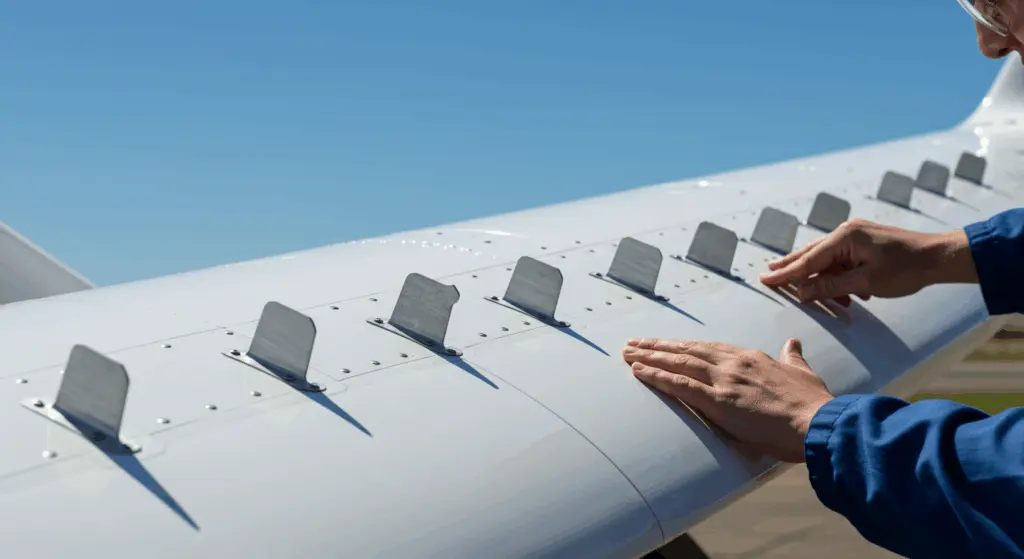
Aircraft wings create an invisible but costly aerodynamic penalty every time they generate lift. This phenomenon, known as induced drag, makes up a substantial part of the resistance an aircraft must overcome during takeoff and landing. The swirling vortices that trail behind wing tips represent wasted energy that engineers reduce through innovations like winglets and optimized wing shapes.
Read More Understanding Induced Drag – A Comprehensive Guide

Understanding Restricted Areas: Definitions and Contexts

Access limitations have different purposes across various domains, from protecting military operations in aviation to preventing dangerous collisions on basketball courts. The boundaries of restricted areas are carefully defined and documented, whether they appear as semicircular arcs on a basketball court or as three-dimensional airspace coordinates in pilots’ navigation systems. Knowing these boundaries and entry protocols helps everyone avoid dangerous situations.
Read More Understanding Restricted Areas: Definitions and Contexts

Understanding the LDA Approach in Aviation

Pilots navigating challenging airport environments often rely on specialized instrument procedures when standard approaches aren’t possible. The Localizer Directional Aid (LDA) approach provides precise horizontal guidance along a path intentionally offset from the runway centerline, allowing access to airports surrounded by terrain or obstacles. Unlike traditional localizer approaches, LDA procedures require pilots to execute an additional alignment maneuver during the transition from instrument flight to visual landing, requiring careful preparation and skilled execution.
Read More Understanding the LDA Approach in Aviation

Graveyard Spiral – Understanding the Aviation Phenomenon

Pilots experiencing a graveyard spiral encounter a lethal mix of physics and physiology working against them. As the aircraft banks and descends in tightening turns, the inner ear’s vestibular system generates the false sensation of straight and level flight, masking the true danger. Without proper instrument training, disoriented pilots have an average survival time of just 178 seconds once visual references are lost—earning it the reputation as one of flying’s quietest threats.
Read More Graveyard Spiral – Understanding the Aviation Phenomenon

Understanding Dihedral: Definition, Properties, and Applications

The angle formed between two intersecting planes appears abstract at first glance, but dihedral angles shape our physical world in surprising ways. From determining how aircraft respond to wind gusts to influencing the three-dimensional structure of protein molecules, these geometric relationships affect everything from flight stability to pharmaceutical effectiveness. Engineers and scientists measure and adjust dihedral angles to achieve specific performance characteristics in their designs.
Read More Understanding Dihedral: Definition, Properties, and Applications

Understanding the Angle of Incidence in Aviation

Aircraft designers carefully position wings at specific angles relative to the fuselage, creating what pilots know as the angle of incidence. This fixed engineering decision affects everything from fuel efficiency during cruise to handling characteristics during takeoff and landing. Unlike the constantly changing angle of attack, the angle of incidence remains constant throughout an aircraft’s operational life, quietly shaping performance across all flight regimes.
Read More Understanding the Angle of Incidence in Aviation

Understanding the Dry Line – Definition and Weather Impact

When a mass of dry desert air collides with humid Gulf air across the Plains states, meteorologists call this boundary a dry line. This atmospheric divide can trigger sudden weather changes within remarkably short distances, transforming clear skies into violent thunderstorms. Across Texas, Oklahoma, and Kansas, this north-south boundary acts as a natural catalyst for severe weather, responsible for approximately 40% of all U.S. tornado reports during active weather periods.
Read More Understanding the Dry Line – Definition and Weather Impact

Understanding Wingtip Vortices – Causes, Effects, and Management
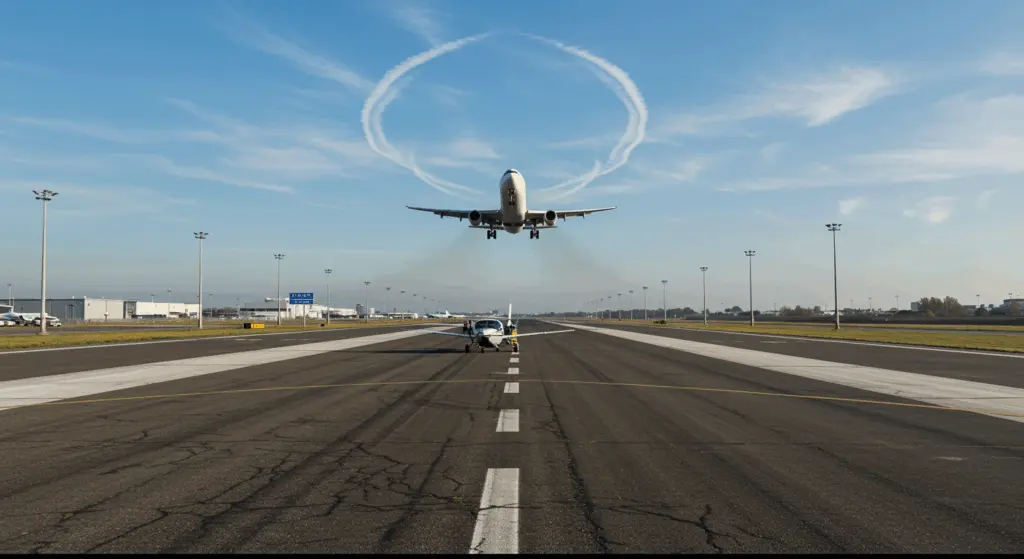
Aircraft leave more than just contrails in their wake—they generate powerful, invisible spirals of air that can toss trailing aircraft around. These wing tip vortices form when high-pressure air beneath the wing curls around the tip toward the lower pressure above, creating rotating air masses that can persist for several minutes after a large aircraft passes. Pilots must carefully time their takeoffs and landings to avoid these hazardous wake turbulence, while aircraft manufacturers design specialized winglets and other devices to reduce their intensity.
Read More Understanding Wingtip Vortices – Causes, Effects, and Management